
Vitality Returns to Regenerative Medicine

For a decade, regenerative medicine told two stories at once. One was careful science moving through trials and approvals. The other was a crowded market of promises that ran ahead of the evidence. In 2026 the first story is winning, and practices that want to be part of it now have firmer ground to stand on.
What regenerative medicine used to mean
Ask most people to picture regenerative medicine and they will describe something close to the image above: a vial of stem cells, glowing with possibility. For years that picture was the whole story. The idea was simple and compelling: living cells that can become other cells, placed where the body needs them. And it was never only an idea. The FDA’s list of approved cellular and gene therapy products includes several cord blood products (HPC, Cord Blood), approved for use in blood-forming stem cell transplantation.
How the picture widened
Then the knowledge base expanded dramatically. Researchers found that much of the activity once credited to the transplanted cells themselves may come from the signals those cells release, such as growth factors, proteins and vesicles acting on the tissue around them (Methods in Molecular Biology, 2016). That one shift opened whole new lines of research, from cell-free approaches, most of which remain investigational, to gene therapies that work at the level of a single gene.
It also changed the question. Stem cells are not the answer to every question in regenerative medicine, and the field no longer regards them as one. The better question is which tool fits which job, and whether that tool has a documented regulatory basis for the job you have in mind.
The science kept moving
While the headlines focused on what went wrong, the formal pathway kept delivering. Every entry on that FDA list went through the full process: trials, review and a license for a specific use. The list is the clearest evidence that regenerative medicine is not a fad. It is a field producing real, approved products, one indication at a time.
The rules got clearer
The second change is less visible and just as important: the lines are easier to see than they were.
- Devices. FDA guidance draws a plain line between the stratum corneum (the skin’s outer, non-living layer) and the living layers beneath it, and explains which claims move a product from one category to another (FDA, 2020).
- Status words. Approved, cleared and listed mean different things, and registration or listing does not denote FDA approval (21 CFR 807.39).
- Biologics. The FDA has said plainly where unapproved cell and exosome products stand (FDA consumer information).
- Peptides. The agency is actively working through which bulk peptides pharmacies may compound; its advisory committee met on the question in July 2026, and its votes are recommendations rather than final action (FDA PCAC).
Clarity is not the enemy of growth. It is what lets a practice build on something.
What the new footing means for a practice
The practices doing well in regenerative medicine today share a few habits. None of them is complicated.
- They carry products with a documented status and can name the product code and regulation for every device on the shelf.
- They describe function, not outcomes. What a device does, in plain words; what a cosmetic does for appearance, and nothing more.
- They read the vendor’s marketing as a regulator would, and do not repeat claims that go beyond a product’s status.
- They disclose relationships. If someone is paid when a product is recommended, patients and partners hear about it.
Where the energy is now
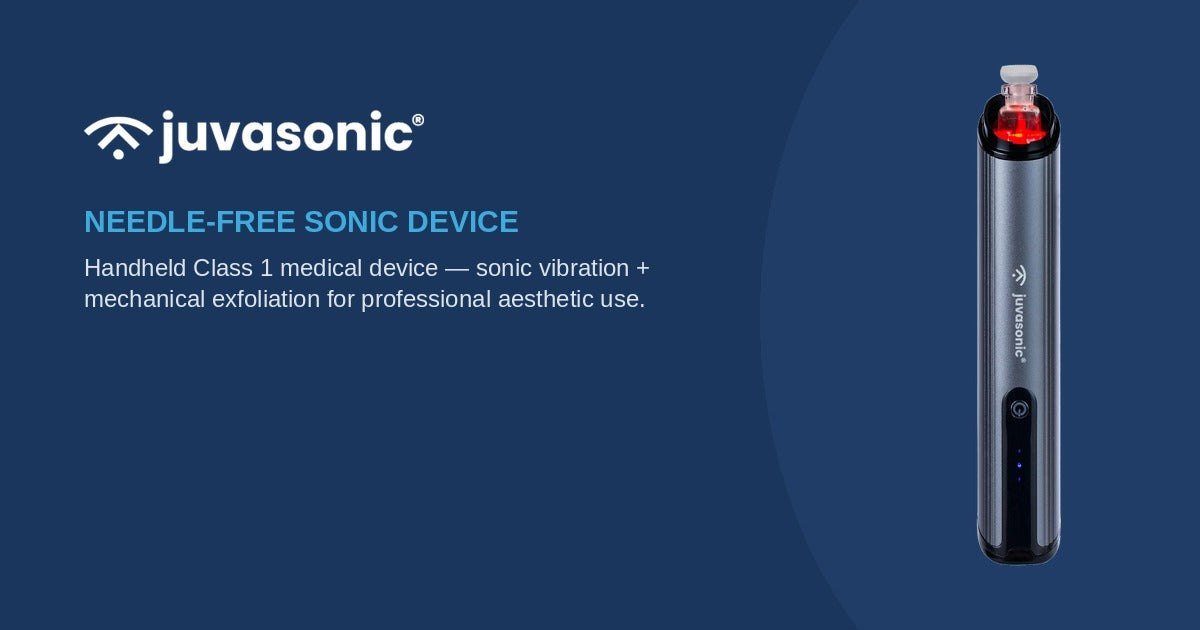
Much of the new momentum is in steps that fit the menus practices already run: needle-free, device-based preparation before a topical product, with a clear regulatory status and cosmetic claims only. JUVASONIC is one example. It is a handheld device that uses sonic vibration and mechanical exfoliation on the stratum corneum, listed with the FDA as a Class I device (product code GED) that is exempt from 510(k) review. Listing is not FDA approval, and we say so on every page. The manufacturer describes a typical session as a “10- to 15-minute add-on service” (manufacturer FAQ).
The next chapter
Vitality in regenerative medicine was never really about the boldest promise. It is about products a practice can explain, document and stand behind. That is exactly what the field is getting better at. Regenerative Direct exists to make that part simple: vetted products, their exact status, and the paperwork, before you commit.
Next step: book a 15-minute JUVASONIC demo, or tell us what your practice is evaluating.
Information for licensed practices, not medical advice. Regenerative Direct expects to be paid by manufacturers when a practice buys through us; see Disclosures.